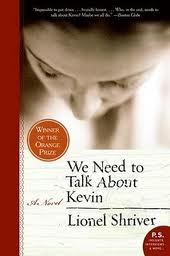
Title: We Need to Talk About Kevin
Author: Lionel Shriver
Pages: 400
 Audience: Adult
Rating: 5 I'd marry this book if it wasn't so ferociously disturbing!
Goodreads Summary:
The gripping international bestseller about motherhood gone awry Eva never really wanted to be a mother - and certainly not the mother of the unlovable boy who murdered seven of his fellow high school students, a cafeteria worker, and a much-adored teacher who tried to befriend him, all two days before his sixteenth birthday. Now, two years later, it is time for her to come to terms with marriage, career, family, parenthood, and Kevin's horrific rampage in a series of startlingly direct correspondences with her estranged husband, Franklin. Uneasy with the sacrifices and social demotion of motherhood from the start, Eva fears that her alarming dislike for her own son may be responsible for driving him so nihilistically off the rails.
Thoughts
This was probably the most interesting and disturbing book I've ever read, although Blindness is a close second. I added it to my favorites shelf not because I "enjoyed" it, but because I think it closely examines a topic that most people skim the surface of in a manner that is brutally honest and fascinatingly presented.
The writing style was very unusual. I'm not sure I liked it, nor am I sure I am meant to. We essentially float in Eva's consciousness through the format of her letters to her dead husband, Franklin. Because of this, the plot becomes very lose and stream-of consciousness-like. We are very rarely grounded to either time or place, and the few scenes that are shown as though they are in "real-time" are very short and out of order. Even Eva's tangents have tangents, so it is easy to get lost in her inner dialogue and sometimes it feels self indulgent of Shriver. I found myself clawing my way through Eva's unlikeable personality to get at her interactions with Kevin.
Eva was interesting because while I both scorned and despised her, I also respected her and related to her. She felt very realistically portrayed, and it's hard for me to view this book as fiction, as a consequence. She represents a lot of fears or dark shameful thoughts that many would think and few would admit. Because she is an unreliable narrator even to herself, it's hard to say how much of her story is imagined and how much is real.
Franklin was a bit disappointing as a character. Compared to Eva he looked like a caricature, and I had trouble buying how much Eva loved and missed him. I would have divorced him in a second after Celia was injured, though I probably would never have married him to begin with. Nor would Eva, despite the necessity of her doing so for the plot. I just couldn't swallow it. He was like an unlikable Rob Swanson from Parks and Rec,
Kevin was brilliantly drawn. He was utterly despicable, revolting, and monstrous. He was also ingenious and pitiable. It would have been far too easy to paint Kevin as pure evil, and it is the few moments where he lets his guard down slightly that Shriver really shines. He never becomes understandable, but his crushing apathy is fascinating. I even found myself (horrifically) relating to aspects of his sense of some of life's pointlessness. You can never really comprehend the why of what he did, though you get close, but you also never stop wondering.
I could have done without the explicit and perverted sex-related scenes, but I suppose they did make sense in the story.
The writing style was very unusual. I'm not sure I liked it, nor am I sure I am meant to. We essentially float in Eva's consciousness through the format of her letters to her dead husband, Franklin. Because of this, the plot becomes very lose and stream-of consciousness-like. We are very rarely grounded to either time or place, and the few scenes that are shown as though they are in "real-time" are very short and out of order. Even Eva's tangents have tangents, so it is easy to get lost in her inner dialogue and sometimes it feels self indulgent of Shriver. I found myself clawing my way through Eva's unlikeable personality to get at her interactions with Kevin.
Eva was interesting because while I both scorned and despised her, I also respected her and related to her. She felt very realistically portrayed, and it's hard for me to view this book as fiction, as a consequence. She represents a lot of fears or dark shameful thoughts that many would think and few would admit. Because she is an unreliable narrator even to herself, it's hard to say how much of her story is imagined and how much is real.
Franklin was a bit disappointing as a character. Compared to Eva he looked like a caricature, and I had trouble buying how much Eva loved and missed him. I would have divorced him in a second after Celia was injured, though I probably would never have married him to begin with. Nor would Eva, despite the necessity of her doing so for the plot. I just couldn't swallow it. He was like an unlikable Rob Swanson from Parks and Rec,
Kevin was brilliantly drawn. He was utterly despicable, revolting, and monstrous. He was also ingenious and pitiable. It would have been far too easy to paint Kevin as pure evil, and it is the few moments where he lets his guard down slightly that Shriver really shines. He never becomes understandable, but his crushing apathy is fascinating. I even found myself (horrifically) relating to aspects of his sense of some of life's pointlessness. You can never really comprehend the why of what he did, though you get close, but you also never stop wondering.
I could have done without the explicit and perverted sex-related scenes, but I suppose they did make sense in the story.


STUNNING review! This one sounds really intense and kind of sad... but almost every person who's read this is saying they loved it, so it's gotta be worth the read! Thanks for your detailed and well-balanced thoughts xo
ReplyDelete♥ Karielle @ Books à la Mode